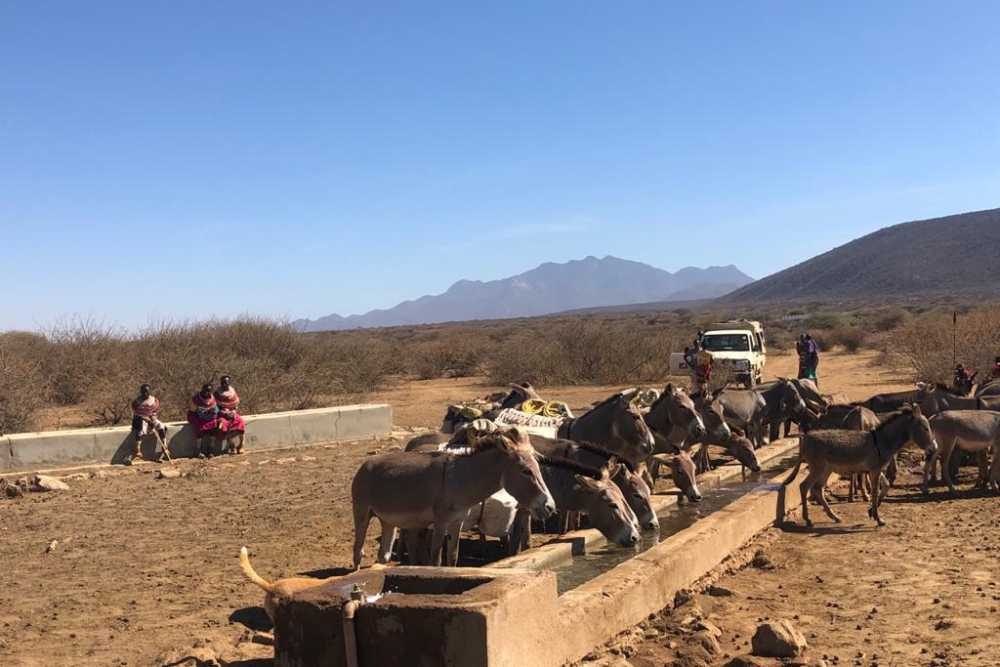
[vc_row][vc_column][vc_column_text]Communities and wildlife in northern Kenya, have been severely impacted by increased incidences of dry spells and droughts that has plagued the region since April. Both the 2020 short rains (October to December) and the 2021 long rains (March to May) were poor across the region which has resulted in a third failed rainy season and fears of prolonged effects might continue on into early 2022. Majority of the people who live in the landscape are nomadic pastoralist families and the increasing heat and recurrent drought cycles has contributed to lack of pasture, loss of livestock and other threats to their health and wellbeing.[/vc_column_text][/vc_column][/vc_row][vc_row][vc_column][vc_empty_space][/vc_column][/vc_row][vc_row][vc_column width=”1/2″][vc_single_image image=”8135″ img_size=”large”][/vc_column][vc_column width=”1/2″][vc_single_image image=”8136″ img_size=”large”][/vc_column][/vc_row][vc_row][vc_column][vc_empty_space height=”20px”][/vc_column][/vc_row][vc_row][vc_column][vc_column_text]In a crisis that is fast becoming one of hunger, thirst, and aggravated pasture and browsing conditions for both livestock and wildlife, the President of Kenya declared the drought crisis as a national disaster on 8 September 2021. Conflict over limited access to resources has increased as pastoralists have been moving in search of water and pasture across the region.[/vc_column_text][/vc_column][/vc_row][vc_row][vc_column][vc_empty_space][/vc_column][/vc_row][vc_row][vc_column width=”1/2″][vc_single_image image=”8137″ img_size=”large”][/vc_column][vc_column width=”1/2″][vc_single_image image=”8138″ img_size=”large”][/vc_column][/vc_row][vc_row][vc_column][vc_empty_space height=”20px”][/vc_column][/vc_row][vc_row][vc_column][vc_column_text]Through concerted efforts with our partners, the Grevy’s Zebra Trust, Westgate Community Conservancy, Buffalo Springs and Samburu National Reserves, Save the Elephants, and community members we are keen to ensure that our landscape continues to be a refuge for wildlife, people, and livestock. In close partnership with the Grevy’s Zebra Trust, we launched a drought relief programme to maintain the health of Grevy’s zebra and other wild prey populations, reduce lion conflict levels, and support communities through this time of crisis.[/vc_column_text][/vc_column][/vc_row][vc_row][vc_column][vc_empty_space][/vc_column][/vc_row][vc_row][vc_column width=”1/2″][vc_single_image image=”8139″ img_size=”large”][/vc_column][vc_column width=”1/2″][vc_single_image image=”8140″ img_size=”large”][/vc_column][/vc_row][vc_row][vc_column][vc_empty_space height=”20px”][/vc_column][/vc_row][vc_row][vc_column][vc_column_text]Our team has been supporting the staff working in reserves through fuel provision and rangers rations, the community through water provision, livestock, and wildlife by digging waterholes during this tough season. We have continued to survey water levels and lion movements to know where we needed to put in the most effort. While we continue to express relief that the river has been flowing again since mid-July, the situation remains dire all around, and our efforts and partnerships remain critical.[/vc_column_text][/vc_column][/vc_row][vc_row][vc_column][vc_empty_space][/vc_column][/vc_row][vc_row][vc_column width=”1/2″][vc_single_image image=”8141″ img_size=”full”][/vc_column][vc_column width=”1/2″][vc_single_image image=”8142″ img_size=”full”][/vc_column][/vc_row][vc_row][vc_column][vc_empty_space height=”20px”][/vc_column][/vc_row][vc_row][vc_column][vc_column_text]As the world reflects on the resolutions made at the COP 26 meeting in Glasgow, we are living with the effects of a climate crisis that pastoralist communities of northern Kenya did not cause. However, we are still working to be part of the solution. Through restoration efforts of our landscapes, we know we can contribute to the grassland carbon sinks that keep the world in balance. We urge the countries who have pushed the earth to the edge to make good on their targets. Meanwhile, we believe these small concerted steps made by our team and partners will contribute towards the overall global agenda and mitigate risks faced by an increasingly variable and changing climate that is adding to the challenges of food insecurity and exacerbating tensions over limited land and water resources by both people and wildlife.[/vc_column_text][/vc_column][/vc_row][vc_row][vc_column][vc_empty_space][/vc_column][/vc_row]

Kura’s Pride – Big news and huge milestones
[vc_row][vc_column][vc_column_text]We are thrilled to announce that this year, we have completed over 3800 dog and cat vaccinations! The vaccination campaigns we have conducted across the landscape have been an ongoing partnership between Kura’s Pride and a number of amazing partners, supporters, and conservancies who are all working together to achieve our collective vision of stopping disease spread in the landscape and improving animal welfare. Some of our highlights of this year’s vaccinations include:[/vc_column_text][/vc_column][/vc_row][vc_row][vc_column][vc_single_image image=”8130″ img_size=”full” alignment=”center”][/vc_column][/vc_row][vc_row][vc_column][vc_empty_space][/vc_column][/vc_row][vc_row][vc_column][vc_column_text]We also produced the first ever Samburu documentary on domestic dog welfare – Ramat Eldein – produced in Samburu language, in concert with the Samburu County Government and partners.[/vc_column_text][/vc_column][/vc_row][vc_row][vc_column][vc_empty_space][/vc_column][/vc_row][vc_row][vc_column width=”1/2″][vc_single_image image=”8168″ img_size=”full”][/vc_column][vc_column width=”1/2″][vc_single_image image=”8167″ img_size=”full”][/vc_column][/vc_row][vc_row][vc_column][vc_empty_space][/vc_column][/vc_row][vc_row][vc_column][vc_column_text]Kura’s Pride has grown in ways we had never dreamed of. As we began our dog vaccinations, ringfencing an outbreak of canine distemper that had claimed the lives of five endangered wild dogs, we were careful to ask the people living alongside wildlife how they felt we should grow the programme. As pastoral people, dependent on and inextricably linked to their livestock, they identified a gap. Their dogs and cats were benefiting from the vaccination campaigns, but after the vets finished the campaign and went home, they had no support for their domestic animals. After much deliberation, we took a giant step forward. We are very pleased to announce that Ewaso Lions (through Kura’s Pride) has partnered with Vet in Wild, Animal Care Centre, and the Foundation for International Aid to Animals to launch a new domestic animal mobile veterinary unit![/vc_column_text][/vc_column][/vc_row][vc_row][vc_column][vc_empty_space][/vc_column][/vc_row][vc_row][vc_column width=”1/2″][vc_single_image image=”8129″ img_size=”full”][/vc_column][vc_column width=”1/2″][vc_single_image image=”8124″ img_size=”full”][/vc_column][/vc_row][vc_row][vc_column][vc_empty_space][/vc_column][/vc_row][vc_row][vc_column][vc_column_text]Dr. Jessicah Kurere leads this veterinary unit with the support of Solomon Lenasalia, our first JLEF university graduate, who is our new Kura’s Pride Officer. Our neat mobile unit is fully equipped including a handy operating table where our operations are performed. The unit has only been operational for a few weeks and Jessicah and Solomon hit the ground running. They have already helped camels and donkeys that were injured badly by lions and hyaenas respectively, performed a number of neutering operations, and helped sick dogs. We are so grateful to all our supporters who have helped us to achieve this dream of ours to improve domestic animal welfare, reduce disease spread and provide sterilizations services.[/vc_column_text][/vc_column][/vc_row][vc_row][vc_column][vc_empty_space][/vc_column][/vc_row]

New Warriors – My Reflections
[vc_row][vc_column][vc_column_text]New Warriors – My Reflections
Shivani Bhalla’s story, as told to Resson Kantai Duff[/vc_column_text][/vc_column][/vc_row][vc_row][vc_column][vc_column_text]I can hear laughing down the hill. Boisterous, belly laughs. The kind that only come from teenagers with too much to prove to each other and the world. I didn’t realise the laughter in this camp has changed. The men I’ve worked with for years are older. Calmer than they used to be.[/vc_column_text][/vc_column][/vc_row][vc_row][vc_column][vc_empty_space][/vc_column][/vc_row][vc_row][vc_column][vc_single_image image=”8011″ img_size=”full” add_caption=”yes”][/vc_column][/vc_row][vc_row][vc_column][vc_empty_space][/vc_column][/vc_row][vc_row][vc_column][vc_column_text]Today I took pictures of eight young warriors in the fading sunlight. They are the newest entrants into our Warrior Watch Programme. As I grinned at their contagious toothy smiles, I was transported back almost 15 years to the Acacia tortillis tree where I met Jeneria, Jeremiah, Francis, and later a whole gang of equally enthusiastic young men.[/vc_column_text][/vc_column][/vc_row][vc_row][vc_column][vc_empty_space][/vc_column][/vc_row][vc_row][vc_column][vc_single_image image=”7999″ img_size=”full” add_caption=”yes”][/vc_column][/vc_row][vc_row][vc_column][vc_empty_space][/vc_column][/vc_row][vc_row][vc_column][vc_column_text]Together we set up a camp using borrowed tents, make-shift tables and stones to demarcate our pathways in the camp. I had no idea what I was doing back then, but I knew why, – and that is what mattered and what kept us going. Lions that ventured out of the reserves either returned very quickly to safety, or never returned at all. The young men around me knew why, and had every reason to resent lion presence. Lions were killers of their cows and goats. But over time, lions became much more to them. We all got to know these lions together. We drew their faces, marked their whisker spots, tracked them on parched sand along the banks of the Ewaso Nyiro. We watched them have families and brimmed with pride as their cubs grew up on community lands.[/vc_column_text][/vc_column][/vc_row][vc_row][vc_column][vc_empty_space][/vc_column][/vc_row][vc_row][vc_column][vc_single_image image=”8009″ img_size=”full” add_caption=”yes”][/vc_column][/vc_row][vc_row][vc_column][vc_empty_space][/vc_column][/vc_row][vc_row][vc_column][vc_column_text]We all grew up. Slowly, the sounds of cheering youth were replaced by little feet. The warriors got married in the most colourful ceremonies. They had children. And finally, I watched the last of the lot take off his beads and feathers, and shave his long ochre-filled mane, the last step before becoming a junior elder. He sat silently with the neat shaved hair in his hands like he was holding the cup of his youth for the last time.[/vc_column_text][/vc_column][/vc_row][vc_row][vc_column][vc_empty_space][/vc_column][/vc_row][vc_row][vc_column width=”1/2″][vc_single_image image=”6740″ img_size=”large” add_caption=”yes”][/vc_column][vc_column width=”1/2″][vc_single_image image=”7991″ img_size=”large” add_caption=”yes”][/vc_column][/vc_row][vc_row][vc_column][vc_empty_space][/vc_column][/vc_row][vc_row][vc_column][vc_column_text]Then came 2020. The year of circumcision, initiation into a new age. We all shed some bitter-sweet tears watching a new group decorate themselves for the first time, and strut their stuff.[/vc_column_text][/vc_column][/vc_row][vc_row][vc_column][vc_empty_space][/vc_column][/vc_row][vc_row][vc_column width=”1/2″][vc_single_image image=”7995″ img_size=”large” add_caption=”yes”][/vc_column][vc_column width=”1/2″][vc_single_image image=”7994″ img_size=”large” add_caption=”yes”][/vc_column][/vc_row][vc_row][vc_column][vc_empty_space][/vc_column][/vc_row][vc_row][vc_column][vc_column_text]Lekalkuli, Lekakwar, Lemarle, Lekoomet, Lekamario, Lekilemo, Lolchuragi and Lkasian are here with new courage, new ideas, new energy. We welcome them.[/vc_column_text][/vc_column][/vc_row][vc_row][vc_column][vc_column_text]Meeting them has made me reflect a lot. Firstly, this new generation is, just like the last, not a homogeneous lot. Too often people talk about the communities that do community conservation as a unit, a living being that thinks the same and acts the same. But people are just people. They are different in their perspectives and actions, and you have to work with everyone if you want to move forward. Today’s new warriors say that they are more attuned to conservation than the previous lot. Maybe they are right. Maybe many of them are. But the challenges are greater than ever, and losing livestock to lions is just as hard, if not harder now. The new warriors have their work cut out for them.[/vc_column_text][/vc_column][/vc_row][vc_row][vc_column][vc_column_text]Most importantly though, this passage of time has taught me that conservation itself takes time. I notice the impatience in the world to solve all our pressing issues. We feel like the world is crumbling beneath our feet. It is. Even I have grown impatient as I watch some of the most precious things vanish. But I disagree with the new wave that seems to promise that in one fell swoop, we can solve everything. I disagree with the new projects cropping up promising to save an entire species in a few months. It can’t be done. Trust me![/vc_column_text][/vc_column][/vc_row][vc_row][vc_column][vc_column_text]Conservation takes time. It takes a lot of people, and a lot of failure and tears. But as I photographed these warriors today, I was reminded that out of all of that, comes resilience and hope. The first time we did this, Jeneria held binoculars in his hands and had no idea what they were or how to use them. It was a while before his passion for lions grew into his very bloodstream. And longer before others wanted to join him. Fifteen years later, dozens have clamoured to get these eight spots to join Warrior Watch. All of them want to be like Jeneria. They want to be there to get camels out of harm’s way at dawn, just like him. They want to go out to see Nanai, daughter of Nashipai, and her new cubs.[/vc_column_text][/vc_column][/vc_row][vc_row][vc_column][vc_column_text]We have come full circle. That is conservation.[/vc_column_text][/vc_column][/vc_row][vc_row][vc_column][vc_empty_space][/vc_column][/vc_row][vc_row][vc_column][vc_single_image image=”7987″ img_size=”full” add_caption=”yes”][/vc_column][/vc_row][vc_row][vc_column][vc_empty_space][/vc_column][/vc_row][vc_row][vc_column][vc_column_text]
- Generously funded by Whitley Fund for Nature, National Geographic – Big Cats Initiative and Houston Zoo.
[/vc_column_text][/vc_column][/vc_row]

Keeping animals wild vs ‘safe’ should be prioritized, lion biologists argue (commentary)
[vc_row][vc_column][vc_column_text]by Pride Lion Conservation Alliance on 14 May 2021[/vc_column_text][/vc_column][/vc_row][vc_row][vc_column][vc_column_text]
- Despite growing media and public pressure to ‘sanitize’ the wild, the priority for conservation should always be keeping populations and areas wild above keeping individual animals safe, six leading lion conservationists argue.
- The power and beauty of a wild lion comes in part from immense struggle, as they battle for food and supremacy: many lions are badly injured or killed in fights with their prey and with one another.
- The urge to intervene and treat injured lions, perhaps even to scoop up their cubs to keep them safe at rescue centers, is of course deeply human. But when we do that, their lives are often degraded and endangered, anyhow, as we go against all we hold dear: the essence of wilderness embodied in these animals.
- Public-pressured, sanitized, and media-friendly management of animal populations will ultimately be crippling for real conservation efforts. This article is a commentary, and the views expressed are those of the authors, not necessarily Mongabay.
[/vc_column_text][/vc_column][/vc_row][vc_row][vc_column][vc_column_text]So why do we have such an enduring and powerful attraction to these incredible creatures? They are clearly beautiful, but that does not explain the depth of their appeal: an Oxford study revealed that people found big cats far more appealing than would be expected purely from their physical characteristics.
That is particularly true for lions: despite not having the striking coloration of a tiger, the appealing cuteness of a red panda, or the immense physical presence of a rhino, they are a predominant wild animal in the human psyche, becoming the world’s most chosen ‘national’ animal. All of us writing this have personally felt that pull: we all run conservation organizations where lions are the focal species, where it is the plight of these animals more than any other that attracts attention from across the globe.[/vc_column_text][/vc_column][/vc_row][vc_row][vc_column][vc_single_image image=”7859″ img_size=”full” alignment=”center”][vc_column_text]
Wild African landscapes support a myriad of species. Photo courtesy of Colleen Begg.
[/vc_column_text][/vc_column][/vc_row][vc_row][vc_column][vc_empty_space][/vc_column][/vc_row][vc_row][vc_column][vc_column_text]The real reason, we believe, for the intense magnetism of big cats is the fact that they are true icons of what it means to be wild. To survive, wild big cats need vast, functioning landscapes, with all the diversity of plants, insects, birds, reptiles and small mammals required to maintain the habitats and prey they depend upon. The scale of the areas that support big, wild lion populations is almost impossible to comprehend, even if you spend hours or days driving through them. It becomes evident only from the air, since you can still fly for hours across immense wild places. For us, it is deeply satisfying that those places still exist. They are fragmented, they are under enormous pressure, but for now we still have some of these spectacular landscapes left, and the presence of wild lions is a reflection of that.[/vc_column_text][/vc_column][/vc_row][vc_row][vc_column][vc_column_text]Contrary to what many assume, wilderness does not have to exclude humans: in many places, the rights, cultures, and lives of local people are exactly what maintains wildlife across these vast areas. Human presence does not negate what it means to be wild: species like lions thrive and continue to be truly wild alongside humans, given enough space, tolerance, security, and value.[/vc_column_text][/vc_column][/vc_row][vc_row][vc_column][vc_column_text]In fact, it is likely that our shared human history with lions has helped make them so uniquely iconic. In Africa, the very evolution of our ancestors was shaped by living alongside this immensely powerful predator. Even today, walking through wild areas of Africa transports us back through time, humbled by the power of nature and reminding us that we humans are a small speck of life within these vast ecosystems.[/vc_column_text][/vc_column][/vc_row][vc_row][vc_column][vc_column_text]To stand and look deep into the amber eyes of a wild lion, even for a few moments, erases millennia of human artifice and arrogance. The fearsome ability to kill with one strike of a paw, the immense strength coiled up in those muscles, and that unflinching gaze that reminds us that humans have long been – and in some places still are – lion prey. It instantly reminds us that when all else is stripped away, we are so much less powerful than they are.[/vc_column_text][/vc_column][/vc_row][vc_row][vc_column][vc_column_text]That power and magnetism comes from being utterly wild. A lion in captivity is still beautiful, but it is a very different animal. The power and beauty of a truly wild lion, as with any wild animal, comes in part from immense struggle. They battle for food and supremacy: lions are badly injured and killed in fights with prey and with one another.[/vc_column_text][/vc_column][/vc_row][vc_row][vc_column][vc_column_text]We have all seen devastating injuries: lions with jaws hanging off or scalps peeled away after battles with buffalo, appalling wounds after bloody, internecine fights, and the particular horror of watching young cubs savaged to death by incoming males after a pride takeover. It is of course deeply human to want to intervene: to treat the injured lions, perhaps even to scoop up the cubs to try to keep them safe. But if we did that, we would be going against all we hold dear: the essence of wilderness embodied in these incredible animals.[/vc_column_text][/vc_column][/vc_row][vc_row][vc_column][vc_column_text]Life in the wild is a brutal, bloody circle: wildebeest must run within minutes of being born to try to escape predators waiting to transform their births into deaths; weak or injured prey animals will often be eaten by carnivores, sometimes while they are still alive. These events are horrible to watch, and seem terribly cruel, but they are part of the lifeblood of nature. It is through these events that you see the true resilience and power of wild animals. We have also seen many animals survive horrific injuries thanks to their innate strength, sometimes aided by pride or pack mates, and those unbelievably resilient animals have gone on to breed, continuing the natural selection that has led to everything we find inspiring about them.[/vc_column_text][/vc_column][/vc_row][vc_row][vc_column][vc_single_image image=”7858″ img_size=”full” alignment=”center”][vc_column_text]
Lionesses must be fierce to protect their cubs. Photo courtesy of Lorenzo Rossi.
[/vc_column_text][/vc_column][/vc_row][vc_row][vc_column][vc_empty_space][/vc_column][/vc_row][vc_row][vc_column][vc_column_text]Pressure to sanitize the wild
However, more and more over the course of our careers, we have seen a push to intervene and manage wild animals and wild places. This is likely another result of the global fascination with big cats, as people across the world – often from the comfort of their homes thousands of miles away – are becoming increasingly vocal in how these species and areas should be managed, often without any real understanding of the complexities involved.[/vc_column_text][/vc_column][/vc_row][vc_row][vc_column][vc_column_text]We see the impacts of this daily. If wild animals are injured or suffering through natural causes – even in supposedly wild areas such as national parks – there is an increasing tendency to rush in and treat them, presumably to avoid upsetting tourists or risk condemnation on social media.
Young or injured animals may be ’rescued’ by people, in acts of kindness that can condemn them to an (often-miserable) life in captivity. This impacts not only those individual animals, but has consequences for the wider ecosystem and natural selection.
Alarmingly, ‘rescue’ centers are increasingly seen by the public as playing an important role in conservation: this is amplified by the media, where beautiful images of humans caring for wild animals suggest this is helping safeguard species. However, these places require significant donor funds, and can amplify conflict as local people see the welfare of wild animals prioritized above their needs.
There is also a risk that if ‘orphanages’ and the like become viable businesses, wild animals could be taken in without sufficient reason, actively damaging wild lives. And while ‘sanctuaries’ can have a role in animal welfare, it is rare (and often unwise) for species like lions to ever be released from these captive situations into the wild, with particular risks of conflict from habituated animals. Ultimately, these places may be little more than a distraction: if we are to save wild large cat species, we need to focus on conserving wild animals and wild places together with the people who share their landscapes.[/vc_column_text][/vc_column][/vc_row][vc_row][vc_column][vc_single_image image=”7860″ img_size=”full” alignment=”center”][vc_column_text]
Male lion and cub. Photo courtesy of Paul Tickner.
[/vc_column_text][/vc_column][/vc_row][vc_row][vc_column][vc_empty_space][/vc_column][/vc_row][vc_row][vc_column][vc_column_text]Prioritizing visible costs risks major hidden harms
This growing pressure to ‘manage’ wildlife and avoid the public awareness of suffering and death can have adverse impacts. In terrible events such as lion attacks on humans, or other clearly ‘problem’ animals, media and public pressure can be so intense that authorities feel unable to shoot the animal concerned, even if that is legitimately the best course of action.
Instead there is increasing movement towards capturing the animal and placing it in captivity, with major welfare implications for a wild animal and major cost burdens for already overburdened governments. There is also a growing move towards translocation: a media-friendly approach, but one beset by many problems. It is expensive, stressful for the animal concerned, hard to find suitable release sites without competing animals or substantial threats, and when it involves conflict-causing animals, it can create problems in local communities around release sites.
Translocation requires monitoring of the released animals and a clear plan for what should happen if it fails, yet this is very rarely done. Animals are often merely moved elsewhere, risking a horrible death, but – apparently importantly – one which happens beyond unforgiving public and media scrutiny.
It is these well-intentioned actions – which reduce visible, public costs, but risk significant, hidden harms – that concern us the most. This is not just about translocation: any interventions or policy changes aimed at ‘saving’ wildlife should be very carefully examined to avoid unintended consequences, such as habitat loss or ‘hidden’ wildlife deaths such as through conflict or snaring. Alarmingly, those deaths – which we have personally witnessed, and know have appalling consequences both for wild animals’ welfare and conservation – seem to be viewed as less important, or as failures. They do not lend themselves to easy campaigns or the photogenic ‘successes’ of rescues.[/vc_column_text][/vc_column][/vc_row][vc_row][vc_column][vc_single_image image=”7861″ img_size=”full” alignment=”center”][vc_column_text]
A lioness in Tanzania shows her battle scars. Photo by Rhett A. Butler for Mongabay.
[/vc_column_text][/vc_column][/vc_row][vc_row][vc_column][vc_empty_space][/vc_column][/vc_row][vc_row][vc_column][vc_column_text]Keeping animals wild should be prioritized over keeping them safe
We are not advocating an entirely hands-off approach to conservation. Wild areas and species will often need to be used and managed to generate revenue, and in some cases intervention is unavoidable and warranted – for instance, treating animals injured through human impacts such as snares or poison. However, the priority should always be on keeping populations and areas wild above keeping individual animals safe. Furthermore, part of our role as conservation scientists and organizations should be engaging with and informing public opinion, rather than being fearful of public pressure.
Ultimately, we find this drive for public-pressured, sanitized, media-friendly, managed areas and animals crippling for real conservation efforts and impact, as well as ethically questionable. It creates a myth of conservation far removed from the gritty reality of balancing human wellbeing and biodiversity conservation. It is based on external pressure, rather than the rights, views, and needs of local people, or even the needs of wild animals and their conservation.
We fear this leads not to the conservation of wilderness, but instead to the preservation of small, fenced areas where nominally wild animals are endlessly managed. We fear these areas and animals being increasingly protected by armed guards against the very local communities who should be engaged and empowered through their conservation, creating a divide and resentment that will be increasingly difficult to bridge.[/vc_column_text][/vc_column][/vc_row][vc_row][vc_column][vc_column_text]It is hard to know how even we, as field-based conservationists – let alone the local communities and others we work with – can have any real impact against this immensely powerful juggernaut of public and media pressure.
It is likely that we cannot: but with whatever voice we have, we call for more considered and informed discussions of these issues, an embracing of complexity and nuance, rather than a fearful bowing to uninformed social pressure empowered by celebrities on social media. Only then, together, can we protect wilderness and the essence of wild animals, in all their untamed reality, ensuring they can continue inspiring humanity for millennia to come.
Founded in 2015 by six leading field-based conservationists – Amy Dickman, Colleen Begg, Shivani Bhalla, Alayne Cotterill, Stephanie Dolrenry, and Leela Hazzah – the Pride Lion Conservation Alliance combines science with community conservation to address the biggest threats to lions and improve the lives of local people. The founding members lead carnivore conservation projects in four key lion range countries, researching and protecting more than 20% of Africa’s existing wild lion population. Together, Pride’s founders have 100+ years of experience.
SOURCE: https://news.mongabay.com/2021/05/keeping-animals-wild-vs-safe-should-be-prioritized-lion-biologists-argue-commentary/[/vc_column_text][/vc_column][/vc_row]

The Resiliency of Conservation
[vc_row][vc_column][vc_column_text]May 6, 2021
By Stephanie Carnow[/vc_column_text][/vc_column][/vc_row][vc_row][vc_column][vc_column_text]It wasn’t long after daybreak when Sintiwan Lekilia left her home, the sun still hung low in the sky casting a warm honey-colored tint over the open savanna. It’s a 45 minute walk to the Grevy’s Zebra Trust (GZT) camp and Sintiwan wanted to get there early. When she arrived, she settled into the workshop amongst an array of zebra-striped cloth, thread, and recently sewn facemasks. Across the hills, Jisana Tampushi is hammering loudly—adding the finishing touches to a ‘tippy-tappy’, a hand washing station operated by a foot pedal. The contraption has attracted a group of curious children, eager to learn from Ewaso Lions (EL) how to properly wash their hands to prevent the spread of COVID-19. Throughout 2020, the collaboration between local people and conservationists at GZT and EL, have helped the communities and wildlife populations in northern Kenya stay healthy in the face of a destructive pandemic.
[/vc_column_text][/vc_column][/vc_row][vc_row][vc_column][vc_single_image image=”7922″ img_size=”full” add_caption=”yes” alignment=”center”][/vc_column][/vc_row][vc_row][vc_column][vc_column_text]GZT and EL have worked together before. They both operate in the same area and employ many of the same conservation techniques. This year, the pandemic forced both groups to adapt. Meetings they once held with locals to reduce conflict with lions now happened in smaller groups and at a safe distance. GZT’s Nkirreten Project, a women’s empowerment project that Sintiwan participates in, typically makes sanitary pads, but has expanded to include facemasks. Together, EL and GZT set up hand washing stations and disseminated healthcare information to boost community safety. As a result, their partnership and the community-led nature of their work has made this area particularly resilient to the health impacts of the pandemic.[/vc_column_text][/vc_column][/vc_row][vc_row][vc_column][vc_single_image image=”7923″ img_size=”full” add_caption=”yes” alignment=”right”][/vc_column][/vc_row][vc_row][vc_column][vc_column_text]Because their community work supports the local pastoral economy, GZT and Ewaso Lions were also able to withstand the worst financial downturns of the pandemic. As the travel industry grinded to a halt in 2020, it heavily impacted many conservation organizations that rely on tourist dollars. Although GZT and EL faced their own unique funding challenges, tourism and conservation are not linked where they operate. Untethered from tourism, their conservation work with locals to protect livestock from hungry lions and manage rangeland habitat for the highly endangered Grevy’s zebra was able to continue with relatively minor adjustments.
[/vc_column_text][/vc_column][/vc_row][vc_row][vc_column][vc_single_image image=”7924″ img_size=”full” add_caption=”yes” alignment=”right”][/vc_column][/vc_row][vc_row][vc_column][vc_column_text]Community engagement is the cornerstone of conservation for GZT and Ewaso Lions, and it cannot function without trust. This trust is strong due to years of working together to help wildlife and people coexist. Additionally, the bond between conservationists and locals is close because these conservationists are not outsiders, they are from the same communities where they operate. Because they are so rooted in the area, conservationists weathered the pandemic right alongside their communities, strengthening trust even more.[/vc_column_text][/vc_column][/vc_row][vc_row][vc_column][vc_single_image image=”7925″ img_size=”full” add_caption=”yes” alignment=”center”][/vc_column][/vc_row][vc_row][vc_column][vc_column_text]When people are hungry or sick, caring for wildlife, understandably, cannot be their priority. This is why humanitarian efforts and protecting wildlife go hand-in-hand. In this unprecedented year, GZT and Ewaso Lions banded together and worked with local people—producing masks with Sintiwan and strengthening health services with Jisana—to ensure their communities were safe and that their efforts to protect wildlife never wavered. In doing so, they demonstrated the truly resilient nature of community-led conservation.[/vc_column_text][/vc_column][/vc_row][vc_row][vc_column][vc_column_text]Source: https://wildnet.org/the-resiliency-of-conservation/[/vc_column_text][/vc_column][/vc_row]

WILD ELEMENTS Foundation launches with unprecedented approach to investing in Women Conservation Leaders
[vc_row][vc_column][vc_column_text]WILD ELEMENTS
For Immediate Release: April 27, 2021
WILD ELEMENTS Foundation Launches With Unprecedented Approach to Investing in Women Conservation Leaders
New Community-Focused Funding Model Disrupts Male-Dominated Philanthropy Dollars.
LOS ANGELES, CA (April 27, 2021) – Today, WILD ELEMENTS is launching its mission in action, the WILD ELEMENTS Foundation. The brainchild of social entrepreneur Nikki Eslami, WILD ELEMENTS consists of three unique organizations accelerating conservation efforts and scaling global environmental change by protecting humankind, animalkind, and plantkind. WILD ELEMENTS Foundation, a purpose driven non-profit, is investing in global conservation efforts through advocacy, philanthropy, and charitable activities—but in a wild, new funding model infusing resources into planet saving efforts led by women, indigenous individuals, and people of colour.[/vc_column_text][/vc_column][/vc_row][vc_row][vc_column][vc_column_text]Far too often marginalized in the environmental space, women-led efforts only receive .02 percent of total global foundation funding[1]. To change that trajectory, WILD ELEMENTS Foundation is launching with an initial investment of $3 million in sustainability and conservation organizations, which are predominantly female-led. Heeding the United Nations urgent call to action on fully implementing the Sustainable Development Goals (SDGs), WILD ELEMENTS Foundation will invest at least $10 million by the 2030 SDGs deadline and prioritize funding for women-led and community-focused work that has the most impact. WILD ELEMENTS Foundation is flipping traditional philanthropy on its head and disrupting giving models in an effort to decolonize it. With more women in decision-making roles, we can more quickly shift power and resources to scale change.[/vc_column_text][/vc_column][/vc_row][vc_row][vc_column][vc_column_text]“We are wildly different by design,” said WILD ELEMENTS Foundation Board Member and CEO of WILD ELEMENTS Nikki Eslami. “Women are on the front lines in the fight to save our planet. We can and must disrupt the status quo by finding ways to feed into their work which is directly impacting local communities for the better. Plus, by partnering women innovators with women advocates, we can elevate solutions through education, inspiration, and activation.”[/vc_column_text][/vc_column][/vc_row][vc_row][vc_column][vc_column_text]WILD ELEMENTS Foundation will use the power of storytelling to raise the voices of women pioneers paving their own sustainable path forward, changing the world one brilliant program at a time. Deemed WILD Innovators by the Foundation, ten women-led projects from across the globe will be partnered with WILD Advocates (artists and influencers) who will utilize their digital platforms to bring much-needed awareness to new audiences. Together, they will accelerate change by sparking conversations, forming the foundation of a conscious community, and building a movement. Each WILD Innovator is receiving a two-year, $100,000 grant for her work. Each WILD Advocate is donating her time and voice to raise awareness. (See below for the inaugural list of WILD Innovators and WILD Advocates.).[/vc_column_text][/vc_column][/vc_row][vc_row][vc_column][vc_column_text]Beyond these initial investments, WILD ELEMENTS Foundation is also making grants to six conservation programs at world-renowned organizations pursuing narrative, cultural, and policy change. Initial partners include MIT Solve (2021 Resilient Ecosystems Global Challenge), National Resources Defense Council (NRDC)’s Rewrite the Future Program, One Earth’s Project Marketplace, The Recycling Partnership, the Rodale Institute, and Wildlife Conservation Network.[/vc_column_text][/vc_column][/vc_row][vc_row][vc_column][vc_column_text]The WILD ELEMENTS Foundation is led by President and Board Member, Heidi Nel, alongside its Board of Directors which includes WILD ELEMENTS Chief Executive Officer and Founder, Nikki Eslami, WILD ELEMENTS Chief Strategy Officer and Co-Founder, Rob Sebastian, National Center for Family Philanthropy (NCFP) President and CEO, Nick Tedesco, and WestRock Company Chief Sustainability Officer, Brandi Colander.[/vc_column_text][/vc_column][/vc_row][vc_row][vc_column][vc_column_text]For more information on the WILD ELEMENTS Foundation, including planned charitable activities, visit foundation.wildelements.com, and visit WILD ELEMENTS on social media @wildelements.[/vc_column_text][/vc_column][/vc_row][vc_row][vc_column][vc_column_text]WILD Innovators and WILD Advocates:
- Innovator: Richelle Thomas, United States (Protect Medicinal Plants at the University of Arizona)
Advocates: Nathalie Kelley and Blu Hunt
- Innovators: Abigail Williams and Jayne Goss, United Kingdom (Farm Urban)
Advocate: Radhi Devlukia Shetty
- Innovators: Erika Allen and Laurell Sims, United States (Urban Growers Collective)
Advocate: AnnaSophia Robb
- Innovator: Krithi Karanth, India (Centre for Wildlife Studies)
Advocate: Stefanie Giesinger
- Innovator: Genesis Butler, United States (Youth Climate Save)
Advocate: Leona Lewis
- Innovator: Sheila Funnell, Kenya (Grevy’s Zebra Trust)
Advocate: Marisol Nichols
- Innovator: Rosamira Guillen, Colombia (Proyecto Titi)
Advocate: Isabella Gomez
- Innovator: Resson Kantai Duff, Kenya (Ewaso Lions)
Advocate: Elizabeth Gillies
- Innovator: Adriana Verges, Australia (Operation Posidonia at UNSW Sydney)
Advocate: Jamie Chung
- Innovator: Dominique Goncalves, Mozambique (Gorongosa National Park Elephant Ecology Program)
Advocate: Ashley Park
[/vc_column_text][/vc_column][/vc_row][vc_row][vc_column][vc_column_text]About WILD ELEMENTS FOUNDATION:
The WILD ELEMENTS Foundation, a conscious catalyst for change, accelerates efforts to restore our global ecosystem. The Foundation is fueled by the Power of Three—a symbiotic union between Animalkind, Humankind, and Plantkind, because one can’t thrive without the other.
Intentionally designed to disrupt philanthropy, the Foundation aims to shift power and vital resources to women, indigenous communities, and people of colour on the frontlines of conservation. By diversifying funding and leveraging creative storytelling, the Foundation makes every grant exponentially more impactful–advancing and scaling environmental change.[/vc_column_text][/vc_column][/vc_row]

Becoming a Wild Innovator for Wild Elements
[vc_row][vc_column][vc_column_text]Today, I am thrilled to have become a Wild Innovator with the newly launched WILD ELEMENTS Foundation on behalf of Ewaso Lions. WILD ELEMENTS consists of three unique organizations accelerating conservation efforts and scaling global environmental change by protecting humankind, animalkind, and plantkind.
[/vc_column_text][/vc_column][/vc_row][vc_row][vc_column][vc_column_text]We are excited about this new journey and partnership, as WILD ELEMENTS shares our ethos of coexistence between people and wildlife, as well as our belief in empowering women to lead in conservation. Heeding the United Nations urgent call to action on fully implementing the Sustainable Development Goals (SDGs), WILD ELEMENTS Foundation will invest at least $10 million by the 2030 SDGs deadline and prioritize funding for women-led and community-focused work that has the most impact.
[/vc_column_text][/vc_column][/vc_row][vc_row][vc_column width=”1/2″][vc_single_image image=”7771″ img_size=”full” add_caption=”yes” alignment=”center”][/vc_column][vc_column width=”1/2″][vc_single_image image=”7780″ img_size=”full” add_caption=”yes” alignment=”center”][/vc_column][/vc_row][vc_row][vc_column][vc_column_text]Last November, the WILD ELEMENTS film crew spent several days in Samburu filming in preparation. Leaning into our values, Ewaso Lions took the opportunity to tell the story of the profile of a conservationist. As we consider what coexistence will look like in the future, we wanted the world to recognize that each member of the community, women, men and children alike can be – and are – conservationists.
[/vc_column_text][/vc_column][/vc_row][vc_row][vc_column width=”1/2″][vc_single_image image=”7772″ img_size=”full” add_caption=”yes” alignment=”center”][/vc_column][vc_column width=”1/2″][vc_single_image image=”7781″ img_size=”full” add_caption=”yes” alignment=”center”][/vc_column][/vc_row][vc_row][vc_column][vc_column_text]I took time to speak about my perception of “wild landscapes” while growing up in city, not grasping that these spaces were stewarded by people. Munteli took everyone on a journey to the Mama Simba school in Sasaab village, where her passion for conservation begun, while Jeneria introduced the new warriors and elders, and their work with lions under our Warrior Watch programme. The team had a walk down memory lane as Shivani, Jeneria, Jeremiah and Francis reminisced about the beginnings of Ewaso Lions at the site of the old camp.
[/vc_column_text][/vc_column][/vc_row][vc_row][vc_column width=”1/2″][vc_single_image image=”7773″ img_size=”full” add_caption=”yes” alignment=”center”][/vc_column][vc_column width=”1/2″][vc_single_image image=”7782″ img_size=”full” add_caption=”yes” alignment=”center”][/vc_column][/vc_row][vc_row][vc_column][vc_column_text]We also teamed up with the Grevy’s Zebra Trust where Sheila Funnel has been nominated as their Wild Innovator, to talk about the importance of keeping the landscape connected in the wake of mega infrastructure development.
[/vc_column_text][/vc_column][/vc_row][vc_row][vc_column][vc_single_image image=”7738″ img_size=”full” add_caption=”yes” alignment=”center”][/vc_column][/vc_row][vc_row][vc_column][vc_column_text]We are watching with growing excitement as the WILD ELEMENTS Foundation flips traditional philanthropy on its head and disrupts giving models in an effort to decolonise it. Of course, this fits in perfectly with all Ewaso Lions efforts to change the conservation narrative and widen the circle for a more inclusive conservation model to emerge.
[/vc_column_text][/vc_column][/vc_row][vc_row][vc_column width=”1/2″][vc_single_image image=”7775″ img_size=”full” add_caption=”yes” alignment=”center”][/vc_column][vc_column width=”1/2″][vc_single_image image=”7783″ img_size=”full” add_caption=”yes” alignment=”center”][/vc_column][/vc_row]

Our 2020 Annual Report is Out!
[vc_row][vc_column][vc_single_image image=”7667″ img_size=”full” add_caption=”yes” alignment=”center”][/vc_column][/vc_row][vc_row cws_row_min_height=”8px”][vc_column][/vc_column][/vc_row][vc_row][vc_column][vc_column_text]We are excited to share with you our 2020 Annual Report as told by the team.
Putting together this report has made us realise that there is so much to celebrate despite the crises we all endured together.
One of our main highlights has been that a whopping 11 cubs were born last year, and all of them have survived! We collared two lions, saved hundreds of lost livestock and supported our community through joyful celebrations and in their toughest moments.
This makes us so hopeful for the future, so proud of our team, and so grateful to all of you who have walked this journey with us, side by side.
We hope you enjoy the report!
The Ewaso Lions Team[/vc_column_text][/vc_column][/vc_row]